We’ve all been there—sitting through a webinar, nodding along, maybe even typing “Great point!” in the chat. You hear something genuinely helpful and think, “I like that approach—I’ll try it.”
And then… you don’t.
You log off, open your inbox, and the ideas vanish into the digital ether.
Our learners do the same thing. They leave sessions understanding what we covered, but not necessarily doing anything differently.
It’s easy to spot when that happens: we talk about concepts like coaching or feedback, and participants respond with, “Yes, feedback is a gift,” or “SBI stands for situation, behavior, impact.” They’ve memorized the model — but they haven’t lived it yet.
That’s where Bloom’s Taxonomy comes in. It’s the roadmap for helping learners climb from simply knowing something to actually using it — and that’s where transformation happens.
The Shift: From Knowing to Doing
Bloom’s Taxonomy is one of those models that sounds academic until you actually use it — and then it changes everything.
When it clicked for me was during a negotiation training I built early in my career. The participants needed to grasp a dozen new concepts, but I realized that “grasping” wasn’t enough. So I flipped the classroom — gave the eLearning pre-work for the Remember and Understand stages, then turned the live session into a training gym where people practiced the skills.
That’s the real opportunity here. As trainers, we’re not just there to transfer knowledge — we’re there to build the muscle.
I often tell other facilitators: “What are we really aiming to do in our time together? Do we just want people to remember a concept, or do we want them to behave differently because of it?”
Most of the time, it’s the latter. But we can’t expect behavior change if our sessions stay stuck in the “remember” zone.
Here’s a quick look at the six levels of Bloom’s Taxonomy:
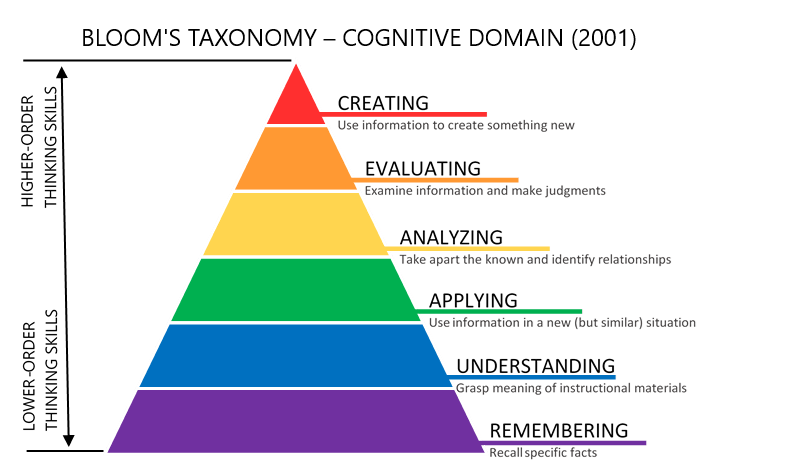
Image source: University of Florida, Center for Instructional Technology & Training — Bloom’s Taxonomy Graphic Description.
| Level | What It Looks Like in Learning | Trainer Tip |
| Remember | Recall facts, terms, or concepts | Ask recall questions, quick knowledge checks |
| Understand | Explain ideas or interpret meaning | Use paraphrasing or “explain it in your own words” prompts |
| Apply | Use the concept in familiar contexts | Have learners demonstrate or role-play |
| Analyze | Break apart and examine relationships | Deconstruct examples or diagnose issues |
| Evaluate | Make judgments or justify choices | Facilitate peer feedback or group critiques |
| Create | Produce something new or design a solution | Ask learners to build, plan, or innovate |
Bloom’s is about movement—from passive recall to active creation. Once learners climb that ladder, knowledge becomes skill.
Now you’re ready to move into The Tool: Designing with Bloom’s Levels in Mind, where you show how to build those stages into your design.
The Tool: Designing with Bloom’s Levels in Mind
Here’s the practical flow I use to design sessions that move up Bloom’s ladder and make learning stick:
1. Start with Relevance (Remember/Understand)
Before diving into models or frameworks, connect the skill to their world.
Ask:
- “What challenges are you navigating right now where this skill could help?”
- “When have you seen this go well—or not so well—in your team?”
This builds a bridge between concept and context. Learners won’t care about SBI, feedback, or negotiation models until they see how it solves something real for them.
2. Expose and Analyze (Analyze)
Now it’s time for hands-on thinking. Show them an imperfect example and ask,
“What’s not working here?” or “How could this be improved?”
Let them retro-fit the example to the model. Let them dissect, critique, and reconstruct. That analytical step deepens understanding and sets up the leap to application.
3. Practice and Create (Apply/Create)
This is where training turns into transformation.
Move from theory into real play (not role play). Have participants map out their next feedback conversation, test it with a partner, and refine it based on feedback.
In that moment, they’re not just “learning about” feedback — they’re doing it.
And the debrief seals the deal:
“What worked? What didn’t? What will you do differently next time?”
The real magic happens when learners leave with a plan and accountability to try it in the wild — and then return to share wins, challenges, and lessons.
If you’re wondering whether you’re hitting Bloom’s higher levels, ask yourself:
“How much time are participants actually practicing this skill in the session?”
If it’s not the majority, you’ve got your next redesign opportunity.
Try It: Redesign One Activity
Before your next training, take one activity and “Bloomify” it.
Add a question that moves learners from understanding to applying — or redesign a section to give them more practice time.
Remember: the training room is the safest place to fail, to wobble, to learn while someone’s still holding the bike seat.
That’s where confidence grows.
That’s where skills stick.
And that’s where you move from being an instructor to being a builder of capability.
Want to help your trainers design sessions that drive real behavior change? 🚀
Check out Letskillup Train the Trainer programs—designed to help facilitators turn content delivery into meaningful learner ownership.
Learn More
If you’d like a deeper dive into Bloom’s Taxonomy and how to apply it in your design work, check out this open-source resource:
“Taxonomies of Learning” from the Derek Bok Center for Teaching and Learning at Harvard University — https://bokcenter.harvard.edu/taxonomies-learning. bokcenter.harvard.edu
It’s smart, free, and trainer-friendly.
 The Trainer’s Blog
Leave a comment